How to Increase Traffic to Your Website in 2023 Using A Results-Driven SEO Strategy

seo strategy

Are you looking for an SEO strategy that will help boost your rankings and visibility in 2023? If so, then this blog post is for you.

SEO is one of the key pillars of all marketing strategies. 2023 brings with it a rapidly evolving SEO landscape. If you want to reach out to potential customers, you must be in sync with users’ search behaviors and continually develop your SEO strategy and efforts.  

Here are the biggest 2023 SEO trends that you need to know as it’ll help you change the way you strategize and develop an action plan this year. 

  1. Embrace Chaos

Expect lots of chaos and dynamism as SEO undergoes a major overhaul this year. We’ve been seeing traces of this trend last year with Google rolling out even more updates than it ever did. 

Google will continue to roll and finish fresh updates as the year progresses. It’s wise to stay on top of these search updates. It might seem chaotic at the outset, but it’s what will precisely bring the much-needed order to the SEO landscape. 

At Webtage, we’d like to add the caveat that while it is our job to stay on top of search algorithm updates and Google’s guidance, great SEO is about improving user experience – if users find your website relevant and useful they will keep coming back and Google will notice! And that’s the reason we don’t lose page rankings to algorithm changes.

  1. Get Acquainted With ChatGPT

​​Talking of Google, ChatGPT (Generative Pre-trained Transformer), the new AI-powered chatbot, has revolutionized search engine optimization. 

The potential of ChatGPT is huge with its easy, human-like conversational interface with users that answers all their queries. It’s no surprise that Google has recently announced its product Bard to compete with ChatGPT.

If you’re an SEO professional who’s not using ChatGPT, we highly recommend using it for your business’ benefit. From keyword research, writing meta descriptions, and using it as a search assistant, to a generic brainstorming tool.  

At Webtage, we use ChatGPT to consolidate research on topics, create meta tags for search engine visibility, and boost our copy creation process for blogs, ads, and the web. However, we strongly advise against using ChatGPT to create content without bringing in your first-hand experience, deep expertise, pointers, evaluation & refinement to make the output useful.

But you can use it to aid you for insights and even outline your content marketing strategy with a bird’s eye view of tactics for content related to your niche. However, if your competition is also using ChatGPT for their content strategy, then they would follow the same thing and create similar content like you. 

Google search engine’s stance on AI-generated content continues to evolve with time. Initially, Google was against any kind of AI-generated content. Now Google’s stance has been that it will penalize any “spammy automatically-generated content.”

Curious if the content you generate can trigger a spam (read “fake content”) alert? Check it here: https://openai-openai-detector.hf.space/

  1. Create Content For People, Not Robots And Spiders

Google released its first “helpful content update” in 2022, urging marketers to create web content that prioritizes people and offers users with a meaningful experience. Google prefers content created for people by people and it views AI-generated spammy content a violation of the company’s guidelines. It states you can use AI for insights and optimization, not long-form content such as articles. 

In 2023, Google is going to favor unique, fresh, relevant, purposeful, and user-centric content. The search engine algorithms are highly sophisticated, quickly spotting content that doesn’t satisfy the readers and has been spun by automated tools. Don’t go that route as there are high chances of getting penalized. 

Google also made an addition to its popular EAT (Expertise, Authority, Trust) acronym in December 2022. The updated acronym reads EEAT (Experience, Expertise, Authority, Trust). This makes sense in a digital world where there’s an influx of AI-generated content. Showcasing the experience of the author or creator builds trust and credibility that it’s written by humans for humans. So, create content that projects your expertise in your subject area. Display an author bio with their detailed experience, a separate author page with a list of all their articles or content, and social profiles. But it’s not just the experience of the author or creator that counts, but also topics of their content should be related to their experience.

With Google’s new guidelines showing a clear preference for long-form resourceful content, fix pages and posts with thin content. For example, product pages can have more details such as dropdown menus, FAQs, and testimonials apart from descriptions.

Focus on quality and not quantity with content creation in 2023. 

  1. Focus on Technical SEO  

In 2023, companies that focus on the improvement of the technical aspects of their websites will grow significantly. Google is incentivizing sites with better user experiences. Better user experience (UX) means higher ranking on the search engine results pages (SERPs). 

There are other key SEO metrics that mean more than ranking and that’s organic traffic via Google Analytics and lead conversions (Leads / Revenue). Unless ranking is affecting a company’s bottom line, it’s not the most important SEO metric to report to your clients. So, organic traffic and lead conversions are standard go-to SEO metrics to focus on. Other factors to measure your SEO performance include indexability, search visibility, time spent on the site, and the bounce rate. 

However, which SEO metrics to measure depends on your marketing goals. Have a bigger picture when analyzing SEO metrics and track a few related ones only. For example, a long time spent on the site might look impressive at the outset, but if it’s not leading to conversions, you’re probably attracting the wrong audience.

Keep an eye on and stay on top of Google’s Page Experience Update, Core Web Vitals, and Link Best Practices to fix technical SEO issues regularly within a certain time threshold. These include monitoring the page loading speed, browser response time, and content stability during loading for a seamless user experience. 

Like content, you’ll see many SEO automation tools and platforms that you can use to perform routine tasks and track technical SEO metrics. 

  1. The Rise Of Visual Or Multisearch

With the increased popularity of TikTok and Instagram, people are steering towards visual content. 

Multisearch was announced in April 2022 to help people view images and text at the same time when they search for something online. Multisearch, powered by Google Lens, allows people to use their phones to search images and text, and get the most relevant results. We can expect more advancements in Google’s AI development and Multitask Unified Model (MUM), a modern technology for answering complex questions that don’t have direct answers. It will provide users with a rich, interactive, and engaging experience as graphic cards of imagery and auto-complete features are directly tied into every search result.

You’ll need to balance the content, i.e. text with images and videos. Also, focus on the mobile optimization of these visual elements as it will become the norm in 2023.

  1. Shoot More Videos

There’s an increased amount of attention to video results when searching for something online. 

2023 will be the year of videos and if you haven’t included it in your SEO strategy, we urge you to do so this year.

The best part is that you don’t need fancy equipment to shoot your videos. Videos taken from your mobile also perform as well as professionally shot videos. The focus is more on the content of the video than the production quality. 

Conclusion

We’ve shared our SEO predictions and insights for 2023. To apply this SEO knowledge to yield results, you’ll need a dedicated SEO expert team, either in-house or by hiring an agency. 

At Webtage, the best SEO Company in Chicago IL, we excel in delivering one of the most comprehensive, realistic, and proven SEO strategies plans with an excellent and consistent track record of implementing the SEO requirements to help our clients achieve their desired results.

Top 5 Reasons Your B2B Company Should Consider LinkedIn Marketing

LinkedIn has come a long way from being just a portal for job seekers. LinkedIn started as a job search engine. But it has now grown into a powerful and integral tool for B2B marketing. 

B2B marketing or Business-to-Business marketing, like the name suggests, refers to marketing products and services to another business, instead of consumers.

Why Is LinkedIn A Crucial Platform for B2B Marketing? 

Let’s explore LinkedIn marketing for B2B businesses and what makes it the perfect social platform for B2B marketing. 

We explore LinkedIn marketing for B2B businesses, and also share our top reasons why you must consider LinkedIn for your B2B marketing. 

  1. LinkedIn Is A Gold Mine Of Business Professionals 

If your B2B company is not on LinkedIn, you’re missing out on enormous opportunities. 

What makes LinkedIn different from the other social platforms is the context. While platforms like Facebook, Instagram, and Twitter have social leanings towards family, friends, and casual connections, LinkedIn is built for business connections only.

Consider this! There are 750+ million users on LinkedIn across 200 countries at the rate of 3 new members every second and counting. 

As per LinkedIn, 71% of professionals use the platform to convey their business decisions. That should convince you how active business professionals are on the platform, promoting their brands. 

It is smart marketing to meet up with other businesses on the platform where they are the most active. If you’re a B2B company, LinkedIn is the place to be. 

So, if you’re not on LinkedIn yet, we strongly suggest you set up your company page at the earliest. You could meet your next business client, partner, employees, influencers and whoever you want to target for your business.  

  1. Social Media For B2B Is Unlike B2C companies 

Unlike B2C or Business-to-Consumer businesses that are aimed at attracting a wider audience of consumers, B2B businesses have a niche audience of other businesses. 

A typical B2C marketing requires a lot of visibility, where the emphasis is geared towards the awareness phase of the buyer’s journey. We measure B2C marketing success more in terms of metrics, such as followers, likes, comments, shares, etc. 

However, B2B marketing runs deeper than just being known to your target audience. There is emphasis on not just brand building, but also on business networking because: 

  • B2B audience spans multiple departments: strategic, financial and operational decision 
  • B2B sales cycles are much longer, so regular communication to provide value for decision makers is critical.

Building a powerful brand gives your B2B business a competitive advantage. Brand building should be a strategic priority to speed up business growth. 

B2B Marketing should be distinct and authentic since there is a demand for purpose-driven brands that fosters trust in the long run among the target audience. Any brand that’s inauthentic and skewed more towards commercialization instead of purpose may not sustain for long. 

Competition is out, and collaboration is in. Brands that are authentic, purposeful, and collaborative are on the right track. 

However, this is easier than done, as most B2B businesses today are blindly following the B2C marketing template. This lack of creativity is damaging to your B2B brand’s success. At Webtage, our approach is to balance brand building and business networking. We carve our clients’ distinct brand personality, and convey it creatively to their audience, building trust, empathy, differentiation, and loyalty.

LinkedIn provides many useful business networking and lead generation tools, including LinkedIn Sales Navigator and LinkedIn Advertising that allow for deep targeting of your audience for best business networking opportunities.

When you’re on LinkedIn, think of the relationships as less as connections and more like collaborative business partnerships. LinkedIn B2B marketing is about building long-lasting partnerships with your relevant target customers.

  1. LinkedIn Is The Most Effective Platform For B2B Marketing 

There are several substantial reasons LinkedIn is so popular with B2B marketers. 

LinkedIn is an excellent place for businesses to promote their products and services and gain relevant business leads. Research has backed the claim of LinkedIn being an effective lead generation platform. An overwhelming 97% of business leads from social media platforms come from LinkedIn. 

Clearly, LinkedIn out beats other social platforms and works for B2B lead generation. When you dig further and look at the reasons backed by research findings, you’ll find that it all makes perfect sense. 

It’s highly likely that you will be in direct contact with high-level decision-makers of the companies you are targeting on LinkedIn. LinkedIn B2B marketing is a faster way to reach your targeted audiences and gain high-quality leads. 

Another reason that makes LinkedIn a popular choice for B2B marketers is that it is viewed as a trusted platform. 

  1. LinkedIn B2B Marketing Helps In Building Thought Leadership

As per a recent study by the Content Marketing Institute

  • 97% of B2B marketers use LinkedIn for their content marketing. 
  • 78% of B2B marketers say LinkedIn is an effective tool for content marketing.

So, LinkedIn is not just a networking place for business professionals, it’s also an active community that’s sharing relevant content. Consider these statistics by LinkedIn internal data:

  • There are nine billion content impressions on LinkedIn each week (LinkedIn study). 
  • Around 45% of LinkedIn article readers are in upper-level positions, such as managers, VPs, Directors, and C-level positions. 

So, as a business brand, you can build thought leadership with your LinkedIn short form posts, videos, and long form articles. There are high chances that the decision makers of your target audience will read them, and even approach you if they are original, high-quality, and well-written. 

  1. LinkedIn is A B2B Centric Platform 

While this might come across as stating the obvious, what most people don’t realize is how LinkedIn is built for B2B marketing. Whether it’s building business relationships, developing your brand, or doing business, LinkedIn is the place to be.

We can use precise and virtually limitless targeting tools and options provided by LinkedIn to reach your audiences. We also use strategic testing to determine which of your audiences and targeting parameter combinations can generate the optimal results.

There are several strategic actions we can take to improve your LinkedIn B2B marketing efforts. For example, we add the LinkedIn Insight Tag to our client’s website so that we can re-target the website visitors with relevant content in the future. 

We Can Help You Gain Leads With Our LinkedIn B2B2 Marketing Services 

LinkedIn is the platform to be on if you have a B2B business. Whether it is to attract relevant, high-quality leads, influencers to promote your products and services, or employees to join your workforce, LinkedIn is the strong dark horse of social media platforms. 

Our article has you covered all the benefits that LinkedIn offers for your B2B business. If you want to know more about how we can help leverage LinkedIn for your business, get in touch with Best Marketing Agency in Naperville & Chicago area.

How B2B Social Media Marketing Can Take Your Business To The Next Level

Social Media Marketing (SMM) is typically seen as beneficial for B2C companies. But this couldn’t be far from the truth. 

If you don’t have a social media plan for your B2B business, you are missing out on huge benefits. Social media is the top distribution method for B2B marketers, with 89% using social tools.

We break down how social media is a fantastic platform to promote your B2B company and when done right, it can have multifold benefits. 

What is B2B Social Media Marketing And How Is It Different? 

While B2C companies use social media marketing to reach out to their audience and influence purchases,  the social media marketing goals for B2B is to sell their products and services to other businesses. 

B2B social media marketing entails strategizing, drafting, promoting, and analyzing content to engage your target audience on social platforms. 

While it might look simple at the outset, there are several nuanced factors including staying abreast of rapidly evolving social platforms and features that make it both challenging and exciting.  

The social media marketing approach for B2B differs from B2C companies. Typically, B2B social media marketing tends to be more strategic to influence business founders and decision makers. It involves relatively more nurturing of business relationships to influence large order purchases. Even the nature of content mix will look different for B2B social media marketing. For example, insightful, and informational videos, case studies, reports, white papers. 

Also, consider these statistics to understand how different the B2B buyer from the B2C customer: 

  • B2B customers spend 27% of their purchase consideration time conducting independent research online.
  • 44% of millennial B2B customers prefer not to interact with a sales rep at all.

B2B buyers are more proactive in their research and enjoy more autonomy in their purchasing decisions. It’s vital that your digital presence and social media marketing are strong for astute B2B buyers.  

[mk_padding_divider size=”100″][highlight_box style=”fade2″ height=”200″ textsize=”20″ iconsize=”18″ icon=”fas fa-search-location” text=”“Social platforms are no longer add-ons to a business’s communication budget; they should be central to its marketing strategy, and used in coordination with other marketing efforts.”
~ Richard Branson” clr=”#000000″ bgclr=”#66cccc” hoverbg=”#aac3c0″][mk_padding_divider size=”100″]

Top 3 Ways  Your B2B company should utilize social media marketing for maximum benefits

B2B social media marketing is one of the best ways to build a strong brand presence and customer loyalty. 

Here are the top benefits of B2B social media marketing. 

  1. Build And Boost Brand Awareness And Repute 

Leverage your company’s social profiles to provide useful information about what your B2B company has to offer for your clients.

Publishing relevant and high-quality content consistently on social media and engaging with your audience via comments and messages helps in improving brand awareness and trust with your customers. 

Sharing your industry expertise and insights by leveraging social platforms establishes you as a thought-leader and helps you stand out from your competition by attracting qualified partners. We are already seeing the benefits of employee branding, especially the increasing digital presence of C-suite leaders, such as the improved trustworthiness of your B2B company. 

  1. Create An Engaged Community And Improve Customer Experience 

Social platforms help you tap into a ‘mostly online’ audience to gain their trust and improve customer experience.  

Your business clients are on social media platforms like LinkedIn, Facebook and Twitter, making it easier for you to build connections and collaborations with them. 

You can interact and help answer your clients’ queries, solve their problems, or thank them for their reviews online whenever possible. It shows them that you’re paying attention to them and are invested in their growth. It makes your brand more humane, approachable and authentic. 

  1. Drive Traffic, Generates Leads, And Increases Sales 

Social media marketing helps achieve your search engine optimization (SEO) goals. Being active on social platforms can improve your company’s positioning in Google’s organic search results, and can help in improving your ranking indirectly. 

“Social platforms are no longer add-ons to a business’s communication budget; they should be central to its marketing strategy, and used in coordination with other marketing efforts.” 

– Richard Branson 

Social media marketing helps drive the relevant traffic to your website, generate qualified leads and increase sales. 

The ultimate goal of all marketing efforts is to promote sales. Social media marketing entails identifying potential clients, positioning their products and services to the targeted prospects, building relationships and trust with them, and nurturing leads. 

It’s Time To Get Social

Social media marketing is a powerful marketing channel for enabling brand authenticity, trust, community and sales. 

As much as it presents a massive opportunity, it is also getting increasingly competitive. 

Looking to improve or initiate social media strategy for your B2B organization? Follow the streamlined 1-2-3-4-5 foundational steps to start your social media marketing on a solid footing!

Contact us to learn more about how Webtage can help you with our innovative and focused approach to social media marketing that can help you stand out from a sea of competitors. 

Top 5 Questions to Ask Your SEO Agency

Deciding to hire an SEO agency is easy. The tricky part is to skim the chaff and find the best SEO agency that helps achieve your business goals and outcomes. 

The global search engine optimization service providers’ industry is expected to grow from $63.19 billion in 2022 to $134.26 billion in 2026. It’s not surprising to see anyone with a computer become an entrepreneur today and start an agency offering their SEO services. But unfortunately, many don’t have the expertise to grow your business. 

This article is to save you the heartache and money from choosing the wrong SEO agency. We list some basic but crucial questions that will help you see through the bells and whistles that agencies offer to bait you. 

What is SEO And Why Is It Important For Your Business? 

Search engine optimization (SEO) is a critical digital marketing pillar for getting traffic organically from search engines. 

However, it is difficult to get your company showing up at the top of the search engine’s front page listings. It takes time, effort, and patience to achieve the desired SEO results. 

Most companies make the mistake of underestimating the importance of having a solid SEO strategy and action plan. 

Some of the main SEO benefits include: 

  • Improves your site ranking on search engine results 
  • Generates organic web traffic without having to pay for each lead 
  • Improves brand awareness, loyalty and advocacy. 

It helps make things easier for Google to find, index, analyze and rank your site. Not investing time in SEO activities can slow down your marketing efforts and hence, lead generation and revenue. 

SEO is a broad umbrella that includes:

  • SEO Audit
  • Link building
  • Keyword Research and Strategy
  • SEO-optimized content marketing
  • Local SEO
  • Voice SEO
  • Technical SEO
  • eCommerce SEO

No one SEO professional can handle the above tasks. Any reputed agency should have a credible SEO team of experts in the respective domains. 

If you have diverse SEO needs and scope of work, then you must consider an agency instead of hiring a freelancer or several freelancers. Hiring an agency will give you a holistic, streamlined, and effective SEO campaign instead of outsourcing the work to several freelancers and ending up with a disjointed campaign. At the worst, hiring several freelancers can hurt your marketing efforts and business.

What You Should Consider Before Hiring An SEO Agency 

You should tread with caution before hiring any SEO agency. Just as an agency has the power to spike your business’ marketing efforts and revenues, it could also ruin your business’ reputation and hurt the bottom-line. 

There are so many unfortunate stories of businesses crashing even before they take off, because of the wrong choice of an agency which scammed them. 

While there will be many agencies that will promise the moon to you at a fraction of the cost, there could be a catch to it. Like adopting black-hat techniques or strategies that go against the platform’s guidelines, or getting tons of irrelevant traffic with badly researched keyword strategies. 

[mk_padding_divider size=”100″][highlight_box style=”fade2″ height=”200″ textsize=”20″ iconsize=”18″ icon=”fas fa-search-location” text=”At Webtage, our primary SEO focus has been on producing high-value content or content that’s original, well-researched, and resourceful for our clients’ target audience. This approach not only builds our clientele’s social repute but also boosts their brand identity with thought-leadership content and creates very valuable backlinks that help with their ongoing SEO efforts.” clr=”#000000″ bgclr=”#66cccc” hoverbg=”#aac3c0″][mk_padding_divider size=”100″][mk_padding_divider size=”100″]

Before you place your trust and hire any SEO agency, I want you to pause and reflect upon the following questions.  

  1. Do You Know Your Goals and Outcomes?

No SEO agency can help you determine your goals and determined outcomes, however good it is. 

There are many SEO agencies with distinct core strengths and specializations. If there is a mismatch in your goals and expectations and their expertise, then it’s a sheer waste of time, money, and effort. 

If your goal is for your website to rank on the search engines’ 1st page for specific keywords relevant to your business that your target audience searches for, then you’ll need an agency whose core strengths include SEO-optimized content marketing. Your strategy will be to attract your audience and educate them with compelling content and pull them into your sales funnels. 

Maybe your goal is to improve the domain authority of your site as you’re losing out ranking for your target keywords despite excellent content because your competitors have higher domain authority sites. You’ll need to find an agency whose core strengths include link building. 

Maybe you’ve noticed that your organic traffic has dropped despite publishing more content. This could mean several problems including a bad robots.txt file or bloated site with duplicate content or something more serious. In that case, you’ll need an agency whose core strengths include technical SEO. 

Maybe you’re a local business that caters only to local customers and needs leads/inquiries from certain locations. In that case, you’ll need an agency whose core strengths include local SEO. 

Knowing your goals and outcomes will help you shortlist the relevant agencies tailored to your needs. Agencies will also prefer to work with clients who are looking specifically for their expertise as they know they can serve them better. 

Based on your goals, desired results, and budget, you can choose an agency that has a specialist focus where it’s focused only on one or few aspects of SEO like technical SEO or a generalist focus where they offer a bouquet of SEO services. 

  1. Does The Agency Have A Defined SEO Process? 

A credible agency will have a unique and holistic SEO process that’s based on its vast experience with diverse clients. They have the experience of going through the ‘trial-and-error’ process in SEO to map out their process on what works to deliver the results every time. 

At Webtage, one of the top Chicago Digital Marketing Companies, our process follows the below 9 unique steps:

  1. Business Understanding & Website Audit

2. Competitor Analysis, including:

  • Backlink research
  • Content research
  • Keyword Focus

3. Keyword Research & Analysis

  • Conversion-ready keyword research
  • Monthly Search Volume
  • Competition Index
  • YoY changes

4. Tag Development & Optimization

  • Title Optimization
  • Description Optimization
  • Heading Optimization
  • Image Optimization
  • Content Optimization
  • Navigation Optimization

5. Technical SEO Analysis

  • Add Sitemaps(XML & HTML)
  • Add Robots.txt file
  • Internal Linking to create topic clusters
  • Structured Data set up correctly
  • HTML & CSS Error Resolution

6.Blog / Article Content Creation

  • High-quality, industry-standard content creation for backlinks and PR

7.Link Building/Promotional Strategies

  • Domain & Page Authority strategies
  • Percentage of Links Building Across Different Platforms Types, including:
    • Guest article publication
    • Local Listing /Business Listing Creation
    • Directory Submissions
    • Classifieds
    • Asset (presentation & video submissions)
    • Q&A activities
  • Spam Score policy

8.Tracking & Reporting

9. Google My Business profile Optimization

A good agency will not simply fix your SEO issues, but have a solid strategy and plan for growing your organic traffic in the long-term. They will have regular goals to achieve over a period to grow your SEO traffic and site every year.  

An agency with a clear and proven SEO process with deep expertise across the various pillars of SEO will grow your business sustainably. 

  1. Does The Agency Have A Knowledgeable And Experienced SEO Team?

There is a lot that happens in SEO and it takes specialized skills and in-depth expertise to be successful in this field. 

Check the credentials of the SEO team of the agency. Most reputed agencies list their team members on their website with their expertise. 

Ideally, the team should have experienced members with their unique strengths. They should have deep industry expertise after working with diverse clients. 

They should not only be able to manage amidst Google’s ever-changing algorithms but also stay ahead of the curve by spotting the future trends and patterns. 

An agency’s SEO team should also be able to give suggestions and recommendations for improvement, such as starting and growing on social channels, launching an optimized content marketing plan, starting a blog, improving the content on your website or the site speed. 

Instead of viewing your SEO partner as being sales-driven, it would do you well to listen to the recommendations and opt for the suggested SEO services that should grow your business. 

It should worry you if the team has no suggestions for improvements as it can tell poorly of their expertise, and it could also be a red flag of dubious SEO tactics to grow your business. 

  1. Does The SEO Agency Produce High-Value Content? 

A common mistake most SEO agencies make is to focus primarily on more mundane SEO-focused tasks, such as building backlinks. They neglect content, which is the major currency of SEO.

Search engines are getting so advanced and sophisticated that a lot of SEO tasks that were necessary a few years back are redundant today. Review the content on the agency’s website, and ask them for the content they’ve created for their client’s websites, social platforms, and other content assets. You should be able to gauge the worth of an SEO agency by the content they create. 

At Webtage, our primary SEO focus has been on producing high-value content or content that’s original, well-researched, and resourceful for our clients’ target audience. This approach not only builds our clientele’s social repute but also boosts their brand identity with thought-leadership content and creates very valuable backlinks that help with their ongoing SEO efforts.

We are cognizant of the audience’s preferences and platform’s best practices to produce both long-form (above 1200 words) and short-form content (below 800-1200 words). Long-form content works best for in-depth blogs, how-to-guides, case studies, and white papers. Short-form content works well on all social platforms, snackable blogs, news articles, infographics, sales copies.

We have led several successful SEO and PR campaigns publishing high-quality content on high DA third-party sites and building the brand reputation of our clients. 

  1. What Is Their Social Proof And Reputation? 

A good agency will be proud to display their client portfolio and testimonials as social proof. They will also showcase their industry-specific thought leadership in the form of in-depth blogs, research papers, and social posts, which reveal how they are the top of the latest SEO trends. Have they published their findings in a report from their exclusive company research and surveys? 

A reputed agency will be happy to share their list of clients, case studies, work samples, testimonials, and references. You can also check their online reviews, and especially the negative ones, to see if there are any red flags that you need to watch out for. Do they have the skills and experience to handle outreach, partnerships, and content promotion with journalists and publications? 

Their website should also be a good indication of how they perform in the SEO domain. If they are doing their SEO well, they can undoubtedly do the same for your business. However, some agencies focus their complete attention on serving their clients, and so you can ask them specifically for their recent client work or a case study.  

  1. What Is Their Company Culture Like? 

While this might seem like an odd question to ask, it is crucial before you sign the final deal. 

If you think about it, an agency is an extension of your business. What are your core business values and company culture? Check if you share a similar culture and values. This will make a fruitful, long-term relationship possible with them. 

You would not want to work with agencies with a toxic culture and environment. Are they realistic and transparent in their communication process? Or do they set unrealistic expectations such as promising you #1 rankings in a record-breaking time? Are they too focused on vanity metrics instead of showing you monthly organic progress on deliverables and reasoning behind their strategy and results? 

If they hide their SEO techniques under the pretext of confidentiality, you may have to think twice about proceeding ahead with them as the chances of a scam are high. 

Why Consider Webtage For Your Business? 

At Webtage, a Digital Marketing Agency in Naperville IL, we excel in delivering one of the most comprehensive, realistic, and proven SEO strategy plans with an excellent and consistent track record of implementing the SEO requirements to help our clients achieve their desired results. 

Why is building a brand image so important?

Why is building a brand image so important? It’s because this is how your customers/clients will remember you. And if there is no brand consistency, there will be only chaos and confusion. Nobody wants to deal with more chaos and uncertainty. Especially now.


Why do we remember brands like Coca Cola, Google, Apple? It’s because they invest in developing and promoting their brand identity. You cannot piece together a brand like a patchwork quilt from a dozen different sources just because it was the cheapest. This isn’t how you create brand loyalty.


Why do people pay more for a MacBook Air when they could get basically the same no-name brand for less than half the price? It’s because of Apple’s carefully constructed branding and image. Their message and their branding is not ONLY carefully constructed, but it’s consistent. It’s not about saving a few pennies or dollars here and there. It’s about an investment in a potentially amazing future.


There is a probably a LOT of competition in your area. What do you want to do to make your business stand out? What is important about YOUR image? What is the image you want to present to the world? You might think that, say, business cards are just a small, meaningless detail, but they are part of a foundation that is building your brand and even something as small as a business card is part and parcel of a consistent message: and part of that message is that YOU pay attention to EVERY detail: not only in your products or services, but your office setting, your website, your branding, your everything. Your image is what is working for you.


Spend the time, discipline and dollars now to perfect the image. Every single thing you put out there is representing YOU. This is the area where you can outshine every other mediocre and same-o same-o-business in your industry. Your business has a lot of potential to be unique and amazing with the right plan. This can be an exciting and creative time, getting your business off the ground or getting it to grow further by putting together a great brand with a good creative and marketing plan! So get out there, form a great team to elevate your brand, and create something amazing.
[mk_padding_divider size=”100″]
[mk_padding_divider size=”100″][highlight_box style=”fade2″ textsize=”20″ iconsize=”18″ id=”01″ text=”You cannot piece together a brand like a patchwork quilt from a dozen different sources just because it was the cheapest. This isn’t how you create brand loyalty.” clr=”#091315″ bgclr=”#b0b948″ hoverbg=”#92c847″ icon=”fas fa-bullseye”][mk_padding_divider][mk_padding_divider][mk_padding_divider][mk_padding_divider]

About the Author

[mk_padding_divider]
[mk_circle_image src=”https://www.webtage.com/wp-content/uploads/2018/10/sandra_circleprofile.png” image_diameter=”150″]

Sandra Mui shines in her role as the Creative Director at Webtage. With over 15 years of experience in creative writing and visual arts, she gets the pulse of the consumer and creates content that strikes a chord.

Having previously worked for advertising agencies, such as Leo Burnett and other boutique creative houses, she has successfully launched Fortune 500 ad campaigns, including those for Procter & Gamble, Kodak Professional Division, Phillip Morris, FILA, Aki Italia & Champion Sportswear.

Sandra has a passion for reading, writing and researching. Her love of words and art gives her a unique vision and ability to put things together in ways that will make your brand pop!

Contact her at sandra@webtage.com

Are you a Healthcare Provider That’s Offering Telehealth Services? This is What You Need to do Right Now!

In response to the COVID-19 pandemic and shelter-in place orders in many areas of the country, many healthcare providers, including hospitals, doctors, and mental healthcare providers, are now providing virtual care. Google has recently rolled out tow new features in Google Search and Maps to allow users to conveniently find telehealth options, “whether it’s to a doctor’s office down the street, the hospital across town, or a national telehealth platform.” You can also clearly communicate your COVID-19 information with your intended audience.

So how do you, as a provider, access these features? Let’s talk about Google Maps first (if you are not familiar with the significance of Google Maps for your healthcare business or have not claimed your Google My Business listing , learn why it’s critical that you do so now and while you’re at it, also learn foolproof tips on optimizing your GMB listing):

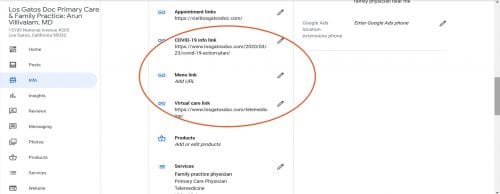
      • Google My Business now offers URLs dedicated to COVID-19 and telehealth services. Make sure you add the URL links to your Google My Business Page listing. After your edits have been reviewed and approved, it’ll appear in Google Maps listing and your detailed Google Maps listing as well. Here’s how you can add the URLs: Sign in to your GMB listing by visiting business.google.com. Next click on ‘Info’ on the left-hand side panel. If you are a healthcare organization, you will see two additional URL options for COVID-19 info link and virtual care link. Add the links as applicable and click Save.
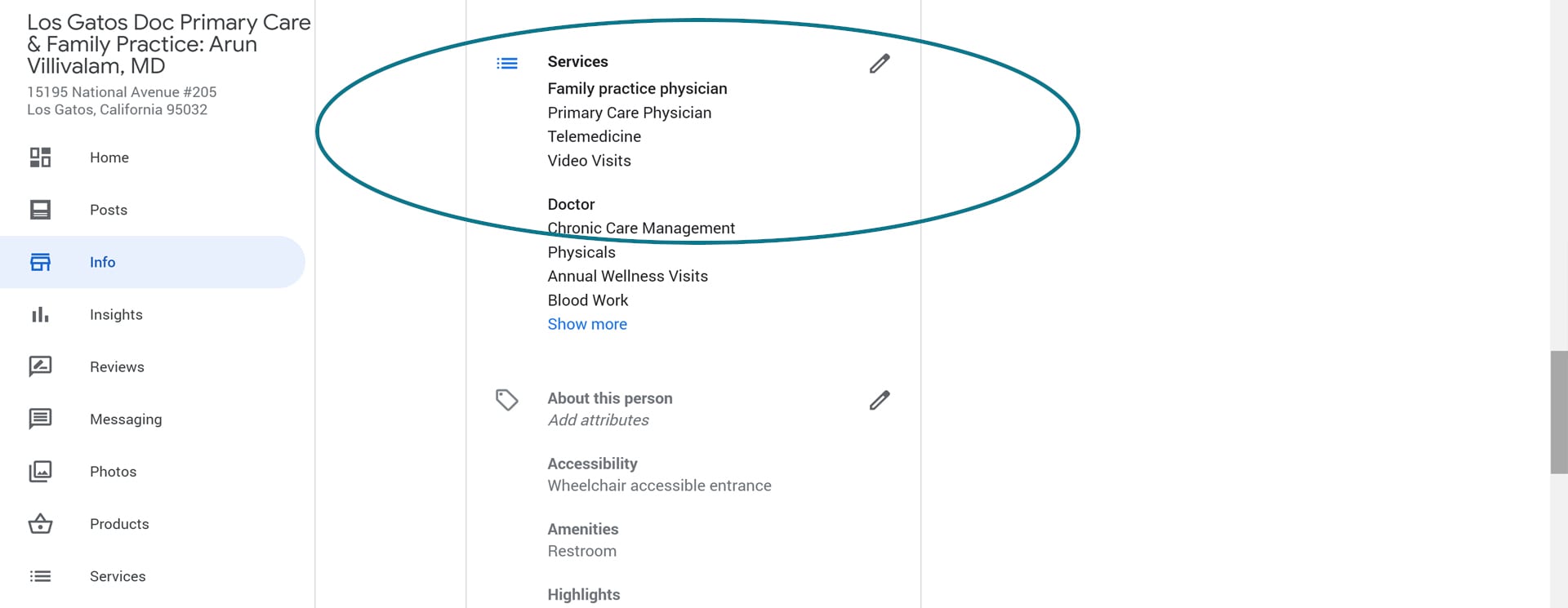
      • List Telemedicine Services on your Business Profile on Google. Google adds that “you can choose what to offer from suggested types of services. If the type of service isn’t listed, you can add your own custom services, like “telemedicine,” “telehealth,” “video visits,” or “house calls.” Once the services edit has saved, patients will be able to see the services you have listed, including online visits or telemedicine.
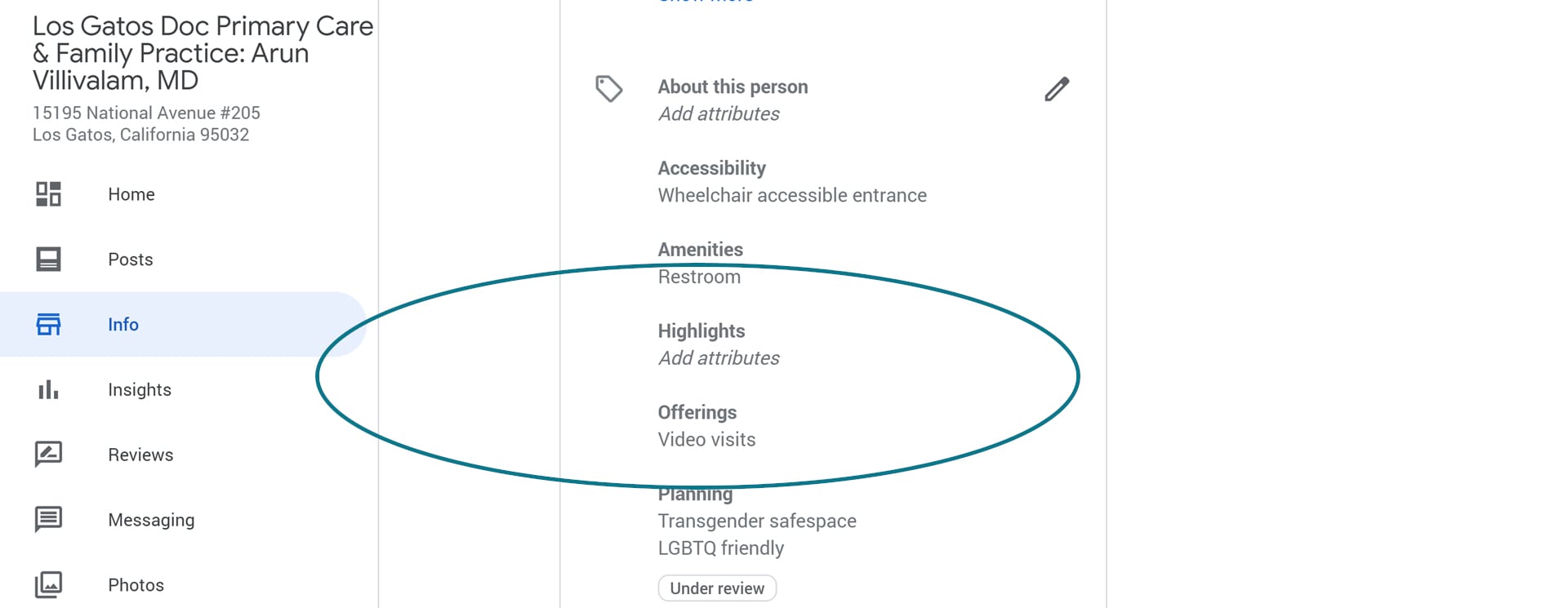
      • Finally, in the Attributes section, add video visits to the offerings, if you do provide video visits. This will also help display your telemedicine option to your patients when they search for your services in Google.

I’d be amiss if I didn’t mention that Google is also helping healthcare providers with technology infrastructure and support via “HIPAA-compliant G Suite products (including using Google Meet for telehealth or virtual visits), deploying virtual agents to field questions related to COVID-19, and helping with capacity-planning and demand forecasting of key medical supplies to better manage their supply chains.”

If you need help planning your transition to virtual care, contact us at Webtage where we have facilitated the transition to online visits for healthcare providers, developed the capacity to communicate high quality and credible information in the midst of the health crisis, and marketed online visits to continue solid revenue generation for our client. 

[mk_page_title_box page_title=”Healthcare Digital Marketing Done Right” page_subtitle=”Grow Quickly & Effectively” section_height=”150″ font_size=”24″ title_force_font_size=”true” sub_font_size=”16″ subtitle_force_font_size=”true”]

Why Google My Business Optimization Should Be #1 on Your Local Marketing Agenda AND Foolproof Optimization Tips

Why is local marketing big business? According to Moz, there are “approximately seven billion unique local searches per month on Google in the United States.” More than 50% of mobile searches have a local intent. If you are a local business and haven’t invested in local digital marketing, you should be thinking about it now.

So how do you market your business for local visibility? In this article, we will focus on strategies to optimize your Google Business Listing to increase your chance of appearing on positions 1-3 of local pack listings (also known as Google Map listings) . These listings appear below paid Ads, but above organic listings. As an example, we searched for “digital marketing near me” on Google and as you can see, at the top of the page are the paid ad listings, followed by Google Map listings. Organic listings appear even further below. So unless you’re running a paid ad campaign, local pack listings are your best bet for Google page 1 visibility.


Main Idea: If you’re looking to appear on positions 1-3 of Local Pack listings, work on optimizing your Google My Business listing as that provides more than 25% of ranking success in Google Local Pack! 

So how do you go about optimizing your Google My Business Listing?

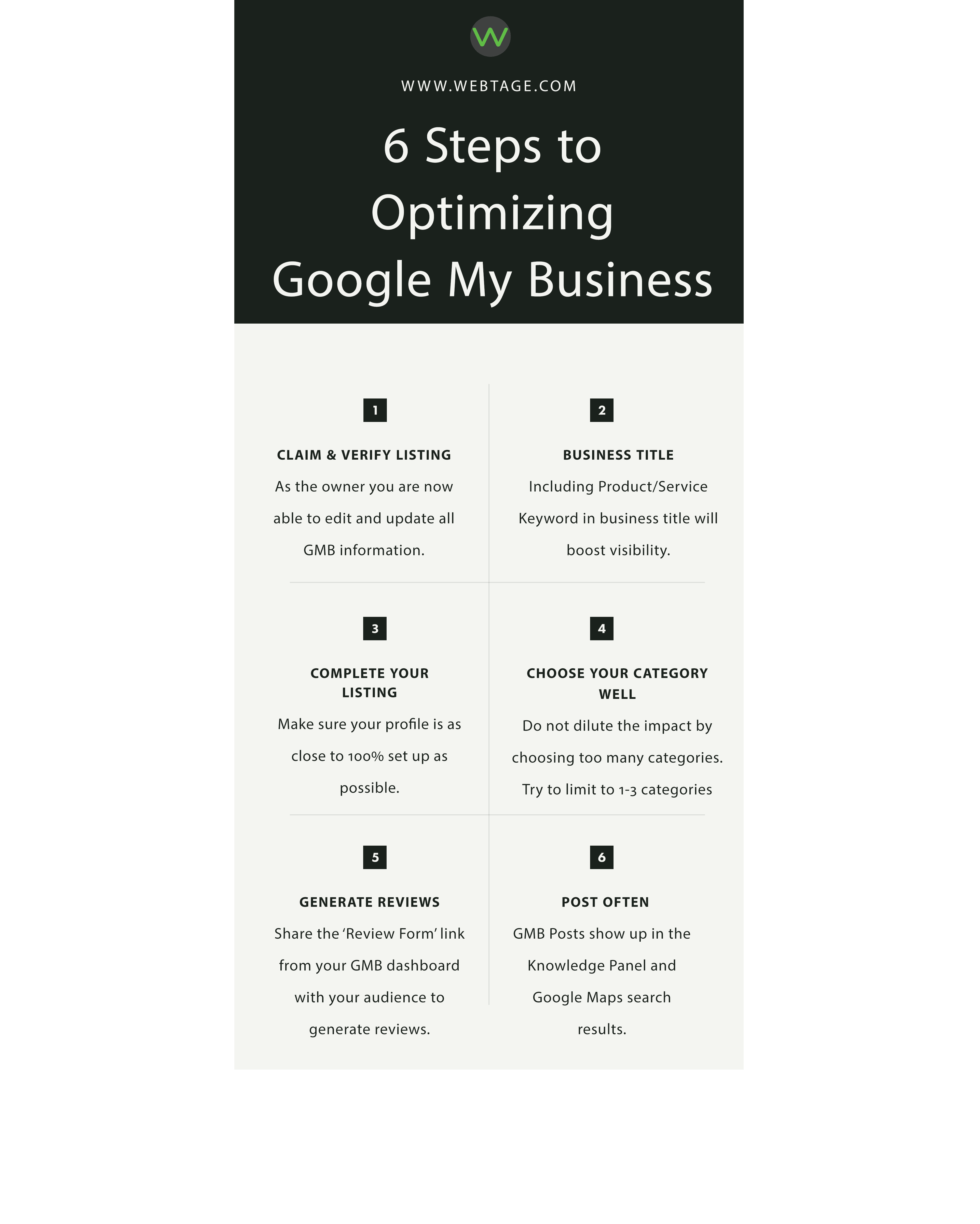
  1. Claim Your Listing and Get it Verified – While you can still post content on your GMB listing even if you’ve haven’t claimed it, claiming your listing will provide you with a lot more control, including responding to client reviews, create posts, or reach out to GMB customer service to resolve issues. So make sure you’ve claimed your listing. If you listing does not exist, create one at by going to google.com/business and select “Start now” in the top right-hand corner. Once you’ve claimed your listing, make sure you verify it by clicking on the “Verify” tab in your GMB dashboard. next, you will be asked to verify your mailing address.  An postcard will then be sent to the mailing address you entered. Follow the steps on the postcard to get your listing verified.
  2. Craft the Business Title Well – Add Business Name. Remember that by adding your product or service keyword improves your chances of ranking for those keywords. Notice that all three local pack listings for “digital marketing near me” (and that includes Webtage as well!) include “digital marketing” in their business name. While this is not a guarantee for a top position, it is certainly a big plus.
  3. Make sure your profile is as close to 100% set up as possible – This includes vital information such as hours, website URLs, services or products, highlights where you can add sttributes such as, “veteran-led” or “women-led,” descriptions, photos and phone numbers.
  4. Choose Your Category Well – Do not dilute the impact by choosing too many categories. Try to limit to 1-3 categories.
  5. Gather Testimonials from Your Customers – GMB makes it very easy to collect reviews if you don’t have enough reviews. Simply share the ‘Review Form’ link from your GMB dashboard with your clients. Also, ensure you respond to reviews posted to your GMB listing. Do not ignore negative reviews. Best ways to respond to a negative review is to acknowledge the negative sentiment and provide solutions to your customer.
  6. Post often – GMB Posts show up in search results in the Knowledge Panel and Google Map search results. You can post about events to promote events at your location. You may also post promotional offers, highlight products, or post announcements.
  7. Communicate With Your Audience –  Answer any questions posed by the general audience. To answer a question posed, navigate to your listing via Google Search and see all questions listed under Q&A section. Navigate to the question you want to answer and hit “answer.” Once you’re done, click “post.” Answering questions posed will help you build customer’s trust and improve search visibility.


Here’s a simple to use infographic on ways to optimize your Google My Listing:

Five Things Marketing Teams Should be Doing During the COVID-19 Shutdown

The Covid-19 pandemic seems surreal and straight out of a science fiction scenario. However, as a wise person said, “It is during our darkest moments that we must focus to see the light.” As we struggle to adapt to the realities of shutdowns, shelter-in-place, work-from-home, or closed-for-business scenarios, remember that shutting down all marketing activities can become a liability when our lives go back to normal. You want to be prepared to ensure top-of-mind brand awareness when demand resurges. So, gather your energy and focus on tasks that can help you help your customers today and tomorrow when the clouds give way to sunshine.


  1. Communicate with your customers – Intimate your customers about what they can expect from your business. Are you shut down for business? Are you open for business virtually? Or is it business, as usual? Pick up the phone and contact your customers. Post updates on your website and social media channels. Create a video with updates and send it to your clients via email – a personalized message works wonders and your customers will be relieved to hear your planned approach directly from you or your team.We recently created a COVID-19 communication plan for our healthcare client, helped them transition to online visits, and then reached out to their patient base as well as prospective audience to let them know about their new service. As part of the communication plan, we designed visuals, videos, door signs, updated the website with updated content, created Q&A documents, and communicated through all owned and earned channels.
  1. Study successful competitors –A slowdown is a perfect opportunity to examine how industry leaders and competitors create unique value propositions as well as business growth strategies and reevaluate your own against those. Is there something you could learn about product positioning, pricing, promotional strategies, places they operate in, and the way they manage their people. Shutdown is a perfect time to reassess your business strategies. A business-savvy client of ours, who operates a transportation logistics and luxury transportation service, is studying how Uber managed to come a long way from being a cab aggregator in 2009. And what better time to adjust your strategies than during a downtime when you have the luxury of time on your side?


  1. Evaluate your content strategy – No matter which vertical you are in, content is the king of marketing and consistency is the queen! So during the slowdown, take a step back, reassess buyer personas, funnel strategy, and content pieces that plug into the funnel. Pull your email, paid and social engagement numbers to see what’s worked in pulling in leads and sales. Channel efforts that work better than others. Repurpose old blogs that got you traction in the past. Here are 5 strategies on how to repurpose old content.


  1. Build Proof Points – This current crisis will pass. Prepare so you can put your best foot forward when customers begin seeking products and services. Collect data, get testimonials, and create case studies. Create brand videos that tell your story. Create product demo presentations that will fuel your sales. You may not be inclined to investing in a full-scale website rehaul but certainly consider updating your website with current content.


  1. Continue to create brand affinity content and stay active on social media – This may not be the best time to market your products or services. Focus instead on building your brand voice and brand awareness. Inspire people to dream about the future. Ask your customers to create wish lists that you can incorporate into your offerings. Finally, leave them with positive vibes.


As Haruki Marukami said in Kafka on the Shore:


And once the storm is over you won’t remember how you made it through, how you managed to survive. You won’t even be sure, in fact, whether the storm is really over. But one thing is certain. When you come out of the storm you won’t be the same person who walked in. That’s what this storm’s all about.


So be transformed and be ready when the storm passes. Because it will.


Let us know how your marketing team is doing during the COVID-19 crisis to be prepared for the present and the future!

Healthcare Digital Marketing: What E.A.T. Means for Your Search Visibility and Why Good Content is Your Best Friend!

In 2018 Google unveiled its “medic update” which had strong implications for businesses in the YMYL (short for ‘Your Money or Your Life’ or in other words websites that provide any information that affects people’s health, wellness, or money). Since more than 40% of websites affected due to this update were health related sites, this came to be known as the “medic update.” There have been further Core Quality Updates in 2019 that continue to have deep implications for search visibility of healthcare organizations.

So what do these updates mean if you are a healthcare provider? Put simply, it means that Google does not want to recommend “uneducated advice, opinions, or potentially fraudulent websites.” Google wants to be certain that the sites that they recommend display a high level of expertise, authority, and trustworthiness.

So how do you signal your expertise, authority, and trustworthiness to Google?

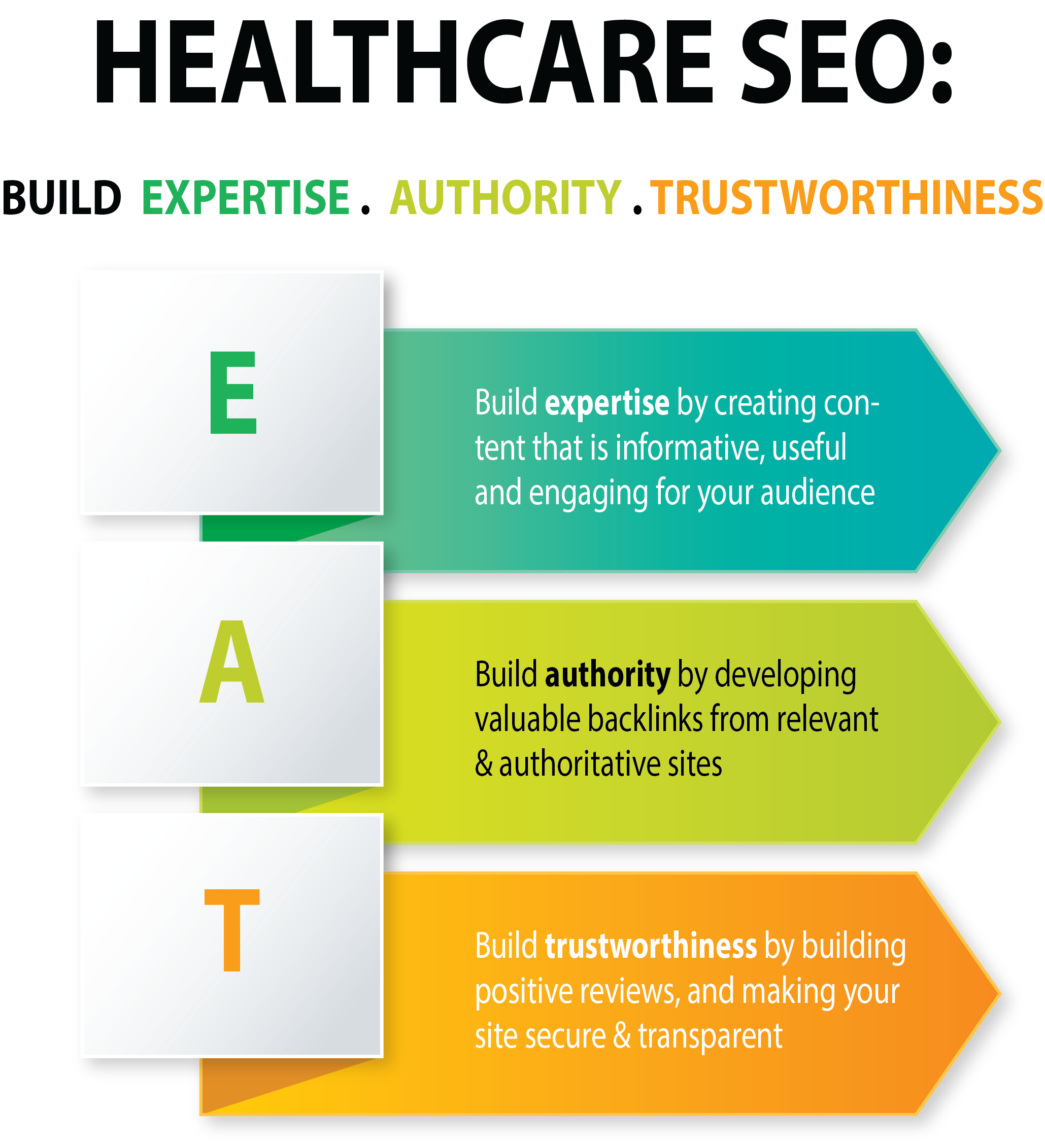
Expertise

  1. Build expertise by creating frequent content that is informative, useful and engaging for your audience.
  2. Remove poor quality, dated content from your website that would signal half-baked, incorrect, or worse, harmful information to your audience.
  3. Keep in mind that it is not only important to build E.A.T. for your website, but also work on building E.A.T. for your content creators. How?


  • Ensure your content creators are experts in healthcare. Google has indicated that “medical advice needs to be written by people with high medical E-A-T to be considered high quality.”
  • You may be a wonderful and experienced doctor, but if you haven’t built your online profile then there is nothing in the digital world to back up your expertise. So strengthen your online expertise by writing guest articles for niche publications in your field and contribute to industry publications and forums.
  • Add by-lines expert to website content. This will signal that the author is an expert in the profession or niche and the information provided in that blog is trustworthy.
  • Link content creator’s profile to other online profiles, especially on authority sites.
  • Use structured data to markup the author’s profile that will allow for a connection to be made with other online profiles for the author.
  1. Cite credible research, statistics, and data in the content that you create.


Authority

  1. Build authority by developing valuable backlinks from relevant & authoritative sites.
  2. Gain backlinks from high authoritative sites naturally by guest blogging for niche high DA (domain authority) sites. Most health-related guest blogging sites have clear guidelines on the types of content they will consider for publication. Identify sites that are the best fit for your specialty.
  3. Create outbound links to high quality health sites & industry publications. Try to include links to research studies or academic journal. Outbound links to .edu or .gov or .org sites are especially useful.
  4. Quality over quantity! Take your time to build good quality links. Building links through automated citation submissions may not be enough anymore.
  5. A good social media strategy will help you market your content and get your content shared – another great way to build authority.

Trustworthiness

  1. Build trustworthiness by building positive reviews. Positive client reviews help in increasing the E.A.T. score, so encourage all the satisfied patients to write testimonials on Google My Business, social media, and review sites.
  2. Many healthcare provider websites allow for email subscriptions, online appointment scheduling, online portal sign-ins etc – all considered to be Protected Health Information (PHI) under HIPPA. This patient data is vulnerable to being stolen unless your site is secured with an SSL certificate. An SSL certificate is not only necessary for you to be HIPPA compliant, it also signals trustworthiness of your website. Google takes privacy of user data very seriously and provides a boost to those websites that signal their intent to protect their user’s information. So make sure your website is secure with an SSL certificate!
  3. Have a clear way for your visitors to contact you with a clearly accessible Contact page.
  4. Include a Privacy Page to let your patients know how you gather, use, disclose, and manage their data.
  5. If you allow for online transactions through your website, ensure that clearly outline your refunds & returns policy.


E.A.T. is not the only update that has had an impact on Google search rankings of healthcare businesses. The 2019 B.E.R.T. is another update that has hit some healthcare sites hard and is about incorporating Natural Language Processing (NLP) into Google searches. And if pages on your website don’t provide information on topics that users are keying into search bars, then your website is likely to be overlooked.


Note the common theme in all the updates? Create content that is informative, useful, and engaging. Google has been saying this for a very long time. Create great content. That has not changed and will not change. See how we used content creation and a solid digital marketing strategy to help a healthcare practice gain top search visibility, increase online patient lead generation, and grow their long-term patient panel 60%.

[mk_page_title_box page_title=”Healthcare Digital Marketing Done Right” page_subtitle=”Grow Quickly & Effectively” section_height=”150″ font_size=”24″ title_force_font_size=”true” sub_font_size=”16″ subtitle_force_font_size=”true”]

40 Questions to Ask Before You Start Healthcare Digital Marketing

A digital marketing campaign needs a strategic approach and careful planning. Advance preparation can help both clients and vendors develop a common understanding of marketing objectives & constraints.

This questionnaire will help you understand your vision for your organization’s growth goals and plan the overall effort required for a confusion- and conflict-free digital campaign. It will help your vendor understand your constraints and will also lower your risk for running into a time and cost overrun.

So whether you are considering improvements to your existing campaign or an extensive omnichannel marketing launch, use this questionnaire to start your digital strategy on the right footing.

    What is Refresh icon

    11 − seven =

    About the Author

    A believer in hype-free and performance driven digital strategies, Snigdha’s endeavor is to get your brand established and your business grow. She is passionate about research, design and analytics and works non-stop and meticulously to make sure that your brand stands out from the rest.

    Snigdha’s background is in research design, industry research, content creation, and qualitative and quantitative research (including web-based and phone survey methods and focus group discussions). She is a highly qualified professional in the areas of digital marketing strategy design, SEO, content creation, and social media marketing. Most recently she has grown a client’s online presence from zero to 25% online leads within 3-6 months; moved client website to the #1 & #2 spots on Google, Bing, and Yahoo for all major keywords; and generated online leads accounting for 25% – 30% of all leads for that client.

    Contact her at snigdha@webtage.com